
Back and neck pain has, for decades, been one of the leading reasons for medical consultation, work absenteeism, and loss of well-being across the population. Its economic and social impact is enormous, as is the technological challenge involved in understanding, measuring, and anticipating how this condition behaves in each individual.
With the aim of providing an innovative solution grounded in scientific evidence, SMART-SPINE was created. This project is funded by the Conselleria de Innovación of the Generalitat Valenciana and developed by a consortium made up of the University of Alicante, Blautic, and Clínica Serra—three organizations that bring together their expertise in biomedical engineering, technological development, and clinical practice.
SMART-SPINE proposes the design, development, and validation of a pioneering technology based on artificial intelligence (AI) and advanced biomedical sensors, seamlessly integrated into a smart textile garment designed to monitor lumbar region behavior in real-life conditions. The goal is ambitious: to provide a tool capable of objectively, personally, and accessibly assessing and helping manage back pain.
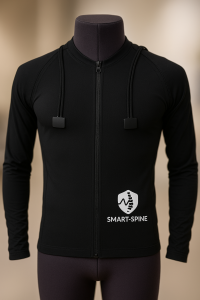
1. A smart garment that captures key information from the body
At the core of the solution lies a textile garment designed to be comfortable, safe, and easy to use in everyday life. This garment incorporates state-of-the-art inertial sensors and textile electrodes, capable of continuously and in real time capturing biomedical data without interfering with the user’s daily activities.
Among the signals collected are:
- Muscle activity (sEMG), which makes it possible to analyze the functioning of the muscle groups involved in movement and lumbar stability.
- Electrocardiogram (ECG) and heart rate variability (HRV), key indicators of both physiological status and stress levels.
- Electrodermal activity (EDA), a particularly relevant signal as it is correlated with the autonomic response to pain.
The combination of these measurements provides a comprehensive view of the user’s condition, one that is difficult to achieve using traditional methods. This multisensor approach not only enables objective monitoring but also opens the door to identifying relationships between posture, physical activity, physiological responses, and pain perception.
2. Artificial intelligence for understanding complex patterns
The truly transformative component of the project lies in artificial intelligence. The system is being trained to accurately and efficiently process large volumes of biomedical data collected throughout the day by the smart garment. Thanks to advanced AI models, SMART-SPINE aims to:
- Identify complex patterns in muscular and physiological activity associated with the onset or intensification of pain.
- Understand the interaction between posture, movement, and biometric signals, providing a holistic view that goes beyond the isolated analysis of each parameter.
- Anticipate future pain episodes, enabling intervention before the condition impacts the user’s quality of life.
- Personalize therapeutic recommendations.
This predictive capability turns the technology into a tool of enormous value for both patients and healthcare professionals, as it complements clinical expertise with objective, real-time data.os objetivos en tiempo real.
3. Validation in laboratory and real-world settings
To ensure that SMART-SPINE delivers reliable results that are applicable to everyday life, the project includes a rigorous validation process carried out both in laboratory settings and under real-world usage conditions. This phase makes it possible to assess:
- The accuracy of the textile sensors across different levels of activity.
- The robustness of signal acquisition during everyday movements.
- The comfort and ergonomics of the garment during prolonged use.
- The ability of the AI model to continue learning and improving with real-world data.
The University of Alicante plays a key role at this stage, leading the experimental design and data analysis, while Clínica Serra provides the clinical perspective needed to ensure that the solution aligns with pain assessment and treatment protocols. Blautic, in turn, is responsible for the technical engineering, sensor integration, and the development of specialized software that enables signal interpretation and automated, AI-driven decision-making.
4. A multidisciplinary collaboration focused on well-being
One of the project’s key strengths lies in the close collaboration between engineering specialists, healthcare professionals, and academic researchers. This synergy allows SMART-SPINE to move forward with a vision clearly focused on the end user: people living with lower back or neck pain who need practical, reliable solutions that are easy to integrate into their daily routines.
From a clinical perspective, the system is expected to become a valuable support tool, improving diagnostic accuracy and enabling the design of more personalized treatments based on both clinical expertise and objective data. For Blautic, this project represents another step forward in its commitment to developing technologies that bring innovation into real life, enhancing health and quality of life.
Looking ahead
SMART-SPINE not only represents a technological solution for today, but also an adaptable platform open to future enhancements. Over time, the system could incorporate new biometric signals, expand its scope to other areas of the spine, or evolve toward applications focused on sports performance or advanced rehabilitation.
What is currently a prototype undergoing validation is shaping up to become a revolutionary tool for understanding and managing pain—combining the power of artificial intelligence with the comfort and natural integration of a smart textile.
At Blautic, we are proud to be part of a project that brings together research, innovation, and healthcare, and that clearly points the way toward a new generation of personalized biomedical solutions.
